This Dog Has Been Returned To The Shelter Four Times And Now He Won’t Even Look At Anyone
This dog has been returned to the shelter four times and now he won’t even look at anyone. I know because I work the front desk. I’ve processed his paperwork every single time.
The first family brought him back after three weeks. Said he was “too much energy.” He was a puppy. Puppies have energy. When they left, he sat at the front door for six hours waiting for them to come back.
The second family lasted two months. Said he didn’t get along with their cat. When they handed him over, he tried to follow them out the door. The woman didn’t even look back.
He still wagged his tail after that one. Still got excited when people came to look at the kennels. Still pressed his face against the glass.
The third family had him for five months. Longest stretch. He’d started to settle. Started to trust. We thought this was it. This was his home.
They brought him back on a Sunday morning. Said they were moving and the new apartment didn’t allow large breeds. He walked into his old kennel like he recognized it. Lay down on the cot. Didn’t eat for three days.
But he recovered. Slowly. Started looking at people again. Started wagging when the volunteers came through.
Then came family number four.
They had him for seven months. He loved them. You could see it in his body when they’d come pick him up. The way he’d lean into the woman’s legs. The way he’d put his head on the man’s lap in the car.
Seven months. Long enough to believe. Long enough to think the leaving was finally over.
They returned him on a Tuesday. Said their child was afraid of him. He’d never shown aggression. Never growled. Never even barked at the kid.
He was just big. And that was enough.
The man carried him in. Set him down at the front desk. The dog looked up at him one last time.
The man said “sorry, buddy” and walked out.
That was three weeks ago.
He hasn’t looked at a person since.
Not the volunteers. Not the staff. Not the families who come through pointing at dogs behind glass.
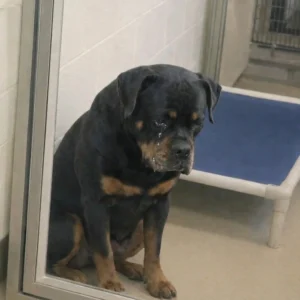
He sits in the back corner of his kennel facing the wall. He eats enough to survive but not enough to thrive. When someone opens his kennel door, he doesn’t move. Doesn’t lift his head. Doesn’t wag.
He’s not sick. He’s not injured. He’s not aggressive.
He’s just done.
Four families taught him to love them. Four families taught him it doesn’t last.
And now he’s decided it’s easier to stop trying than to have his heart broken a fifth time.
I’ve worked at this shelter for six years. I’ve seen hundreds of dogs come and go. But I’ve never seen one give up like this.
Until yesterday, when something happened that I wasn’t prepared for.
His name is Duke. The first family named him that. Every family after kept it. It’s the only thing they let him keep.
Duke came to us originally as a stray. No chip. No collar. About eight months old. Skinny but not starved. Someone had owned him but we never found out who.
He was a good dog from day one. House-trained already. Knew basic commands. Gentle with the staff. Good with other dogs. The kind of dog that should get adopted in a week and never come back.
But he’s a Rottweiler. Eighty pounds. Broad chest. Big head.
People see him and cross to the other side of the hallway. Families with kids take one look and move on to the Labs and Golden Retrievers.
The families that did take him home always started out excited. Always said they didn’t care about breed stereotypes. Always said they wanted to give him a chance.
And then something happened. Always something small. Something that had nothing to do with Duke and everything to do with their own fear or inconvenience.
Too much energy. Doesn’t like our cat. New apartment. Kid is scared.
Four times.
After the fourth return, our vet did a behavioral assessment. Standard procedure for dogs showing signs of depression.
“He’s shutting down,” Dr. Reeves said. “Learned helplessness. He’s figured out that nothing he does changes the outcome. So he’s stopped trying.”
“Can he come back from that?” I asked.
“Maybe. If someone gives him stability. Real stability. Long-term, patient, consistent love. The kind that doesn’t come with conditions.”
“And if nobody does?”
Dr. Reeves looked at Duke through the kennel glass. Duke was facing the wall.
“Then he’ll keep fading. Dogs aren’t designed to live without connection. He’ll eat less. Sleep more. Eventually his body will follow where his spirit already went.”
That sentence haunted me.
His body will follow where his spirit already went.
I tried everything. Spent extra time with him. Sat in his kennel during my lunch breaks. Brought him special treats. Talked to him.
Nothing.
He’d acknowledge the food after I left. Eat it when no one was watching. Like he didn’t want to give anyone the satisfaction of thinking they’d helped.
The volunteers tried too. Janet, who’s been here longer than anyone, spent an hour reading to him one afternoon. Said her voice might soothe him.
He didn’t turn around.
Marcus, our strongest volunteer, tried taking him for a walk. Duke went. Walked beside Marcus obediently. But his head stayed down. His tail stayed still. He moved like a ghost. Present but not really there.
“It’s like walking a shadow,” Marcus said when he brought Duke back. “He’s alive but he’s not living.”
Three weeks of this. Every day I’d come in hoping something had changed. Every day it was the same. Duke in the corner. Facing the wall. Breathing.
I started to lose hope too. Started thinking maybe some dogs just break and can’t be fixed. Maybe four rejections is the limit. Maybe there’s a threshold where a heart just stops trying and nothing can restart it.
Then yesterday happened.
A man walked in around 2 PM. Older. Maybe mid-sixties. Gray hair. Weathered face. Flannel shirt tucked into jeans. He moved slowly, like his body hurt, but his eyes were sharp.
He didn’t look at the puppies in the front kennels. Didn’t stop at the popular dogs. Didn’t ask about breeds or ages or adoption fees.
He came straight to the front desk.
“I’d like to see the dog nobody wants,” he said.
I blinked. “I’m sorry?”
“The one who’s been here the longest. The one everybody passes by. I want to see that one.”
“Can I ask why?”
He looked at me for a moment. “Because I know what it’s like to be that dog.”
Something in his voice made me not ask anything else. I just walked him back to kennel 11.
Duke was in his usual spot. Corner. Wall. Back to the world.
“This is Duke,” I said. “He’s been returned four times. He’s. He’s having a hard time.”
The man looked through the glass for a long time. Didn’t say anything. Just watched Duke’s back. The slow rise and fall of his ribs.
“Can I go in?” he asked.
“He won’t interact with you. He doesn’t respond to anyone right now.”
“That’s fine. I don’t need him to.”
I opened the kennel door. The man walked in slowly. Duke didn’t react.
The man lowered himself to the concrete floor with a grunt. Bad knees, probably. He sat about four feet from Duke. Back against the opposite wall.
And he didn’t say a word.
No “good boy.” No coaxing. No reaching out. He just sat there.
I watched through the glass. Five minutes. Ten. Fifteen. Neither of them moved.
At twenty minutes, I almost went in to check. But something stopped me. A feeling. Like I’d be interrupting something important even though nothing visible was happening.
At thirty minutes, the man shifted slightly. Stretched his legs out. Settled deeper against the wall.
Duke’s ear twitched. Barely. But I saw it.
At forty-five minutes, Duke’s head moved. Just slightly. A small turn. Not enough to see the man. But enough to acknowledge he was there.
The man didn’t react. Didn’t move toward him. Just kept sitting.
At one hour, Duke turned his head fully. For the first time in three weeks, he looked at a person.
The man met his gaze. Didn’t smile. Didn’t speak. Just looked back.
Two broken things. Seeing each other.
Duke held his gaze for maybe thirty seconds. Then turned back to the wall.
The man stood up slowly. Walked out of the kennel. I closed the door behind him.
“I’ll be back tomorrow,” he said.
“You don’t want to adopt him today?”
“He’s not ready. And neither am I. But I’ll be back.”
He came back the next day. Same time. Same flannel shirt. Sat in the kennel for an hour. Same silence.
Duke looked at him twice that day. Longer each time.
Day three. The man brought a book. Sat in the kennel and read quietly. Not to Duke. Just to himself. Like he was sharing space, not demanding attention.
Duke turned around fully for the first time. Faced the man instead of the wall. Didn’t approach. But he watched him read.
Day four. The man sat down in his usual spot. After twenty minutes, Duke stood up. My heart stopped.
He walked three steps toward the man. Then lay down. Still a few feet away. But closer. Facing him.
The man kept reading. Turned a page. Didn’t look up. Like he understood that making a big deal out of it would ruin it.
Day five. The man arrived and Duke was already facing the door. Waiting.
Not wagging. Not excited. But aware. Present. Something had shifted behind those brown eyes.
The man sat down. Duke walked over. Slowly. Carefully. Like he was testing whether the floor would hold.
He stopped about a foot away from the man. Stood there for a long moment.
Then he lay down and put his head on the man’s boot.
The man closed his book. Set it aside.
Very slowly, he reached down and put his hand on Duke’s head. Just rested it there.
I was watching through the glass. Tears streaming down my face.
Duke closed his eyes.
The man closed his too.
They stayed like that for an hour.
On day six, I finally asked the man his name.
“Walter,” he said.
“Walter, can I ask you something?”
“Sure.”
“Why this dog? Why Duke?”
He was quiet for a moment. Looked toward the kennel where Duke was lying down. Facing the door now. Waiting for Walter.
“My wife died two years ago,” he said. “Married forty-one years. After she passed, my kids tried to help. For a while. Then they got busy. Stopped calling. Stopped visiting. They didn’t mean to. They just. Life moved on for them. It didn’t move on for me.”
He rubbed his hands together. Working hands. Scarred and rough.
“I spent a year in my house alone. Sat in my chair. Faced the TV but didn’t watch it. Ate because my body made me. Slept when I couldn’t stay awake anymore.”
He looked at me.
“Sounds familiar, doesn’t it?”
I looked at Duke. Corner. Wall. Eating when nobody’s watching.
“I know what it feels like to have people stop coming,” Walter said. “I know what it feels like to decide it’s not worth looking up anymore. And I know that the only thing that would have helped me is if someone had just sat down next to me and not asked me to be okay. Just been there.”
“Is that what you’re doing for Duke?”
“I’m doing for him what I wish someone had done for me. I’m showing up. Every day. Not asking for anything. Just being there until he’s ready to believe it’s real.”
“And if he’s never ready?”
“Then I sit with him anyway. He shouldn’t have to face that wall alone.”
Day seven. Walter arrived and opened the kennel door himself. We’d given him permission.
Duke stood up when he saw him. Walked over. Not slowly this time. Deliberately. Directly.
He pressed his body against Walter’s legs. Full contact. Leaning.
Walter put both hands on Duke’s head. Duke looked up at him.
And his tail moved. One wag. Small. Tentative. Like he was testing whether it still worked.
Walter’s eyes filled with tears. He crouched down. Duke pushed his face into Walter’s chest.
“I know, buddy,” Walter said. “I know. It’s scary. But I’m not going anywhere. I promise.”
Duke’s tail wagged again. Stronger.
I was standing at the end of the hallway trying not to make a sound because I was crying so hard I could barely see.
Walter adopted Duke on day ten. Not because Duke was fully healed. He wasn’t. Not because Walter was fully healed either. He wasn’t.
But because they’d found each other. And that was enough to start.
The paperwork took twenty minutes. Walter filled out every line carefully. When he got to the section about previous pet experience, he wrote: “None. My wife was allergic. But I’ve been practicing patience my whole life.”
I handed him the leash. Duke was sitting at Walter’s feet. Calm. Not facing the wall. Not facing the door. Facing Walter.
“He might have setbacks,” I warned. “He might get scared. Might withdraw again. Four returns is a lot of trauma.”
“I know about setbacks,” Walter said. “Had a few myself this year. We’ll figure it out together.”
He clipped the leash on. Duke stood up. Looked at the kennel one last time. Then looked at Walter.
“Ready?” Walter asked.
Duke leaned against his leg.
They walked out together. Slow. Steady. Two souls who’d been facing the wall, finally turning around.
Walter sends me photos. Every week without fail.
Week one: Duke lying on a dog bed in Walter’s living room. Not on it, actually. Next to it. On the hardwood floor. Like he didn’t believe the bed was really his.
Week two: Duke on the bed. Just barely. One paw hanging off like he was ready to retreat.
Week three: Duke fully on the bed. Asleep. Walter’s slippers next to him.
Week four: Duke on Walter’s lap. Eighty pounds of Rottweiler on a sixty-five-year-old man’s lap. Walter’s caption: “My back is going to regret this. My heart won’t.”
Week eight: Duke at the park. Tail in motion. Blurry because he was running. Walter wrote: “First time he’s run since I brought him home.”
Week twelve: Duke and Walter on the couch. Both asleep. Walter’s hand on Duke’s side. Duke’s head on Walter’s chest.
The caption just said: “Home.”
I’ve taped that photo to my desk at the shelter. Right next to my computer where I process surrender forms and adoption papers and return paperwork.
On bad days, when another dog comes back and I see that look in their eyes, I look at that photo.
I think about Duke facing the wall. About four families who said “sorry, buddy” and walked away. About a dog who decided love wasn’t worth the risk.
And I think about Walter. Who walked in and asked for the one nobody wanted. Who sat on a concrete floor for seven days without asking for anything in return. Who understood that healing doesn’t happen on a schedule.
People ask me how I do this job. How I watch dogs get returned and heartbroken and given up on.
I tell them about Duke and Walter.
I tell them that sometimes two broken things find each other at exactly the right moment. That sometimes the one who’s been given up on meets the one who refuses to give up. That sometimes love isn’t a lightning bolt. It’s a man sitting on a concrete floor with a book, waiting for a dog to turn around.
Duke was returned four times. Four families decided he wasn’t worth keeping.
Walter decided he was worth sitting on a cold floor for ten days.
That’s the difference. Not between good people and bad people. But between love that has conditions and love that doesn’t.
Duke doesn’t face the wall anymore. He faces Walter.
And Walter doesn’t sit alone in his chair anymore. He sits with eighty pounds of proof that it’s never too late to turn around.